
티스토리 뷰
노션에다 정리한걸 그대로 가져와봤는데 안되서 html을 긁어왔더니 되네요.. 노션에서 작성된 형식을 그대로 옮기는게 꽤 불편하네요
Continuous State Space Model of Linear Time invariant System
x˙=Ax(t)+Bu(t)y(t)=Cx(t)+Du(t),t≥0{\dot x} = Ax(t)+Bu(t) \\ y(t) = Cx(t)+ Du(t), t\geq 0, (1)
The matrix exponential function as
ddteAt=AeAt=eAtA{d\over dt}e^{At} =Ae^{At}=e^{At}A , (2)
Multiplying both sides of (1) by
e−Ate^{-At}, we obtain(3)
e−Atx˙(t)=e−AtAx(t)+e−AtBu(t)e^{-At}{\dot x(t)} = e^{-At}Ax(t)+e^{-At}Bu(t), (3)
Substituting (2) into (3)
e−Atddtx(t)=−ddte−Atx(t)+e−AtBu(t)e^{-At}{d\over dt}x(t) = -{d\over dt}e^{-At} x(t) + e^{-At}Bu(t)
→ddt[e−Atx(t)]=e−AtBu(t)\rightarrow {d\over dt} [e^{-At}x(t) ] = e^{-At}Bu(t), (4)
Integrating the result of multiplying
dtdt both side of (4)
e−Atx(t)∣0t=e−Atx(t)−x(0)=∫0te−AτBu(τ)dτe^{-At}x(t)|^{t}_{0} =e^{-At}x(t)-x(0) = \int^{t}_{0}e^{-A\tau}Bu(\tau)d\tau, (5)
Rewriting the equation (5), we get the solution of the state-space eq of LTI system.
x(t)=eAtx(0)+∫0teA(t−τ)Bu(τ)dτx(t) = e^{At}x(0) +\int^{t}_{0}e^{A(t-\tau)}Bu(\tau)d\tau, (6)
Discretize the continuous state space model
In an analog control system, the control input is updated continuously, while in a digital control system, it is held constant within each sampling period.
To accurately represent this behavior in a system model, discretization must be applied. we use the Zero-Order-Hold(ZOH) method in this contents.
x(t)=eA(t−t0)x(t0)+∫t0teA(t−τ)Bu(τ)dτx(t) = e^{A(t-t_0)}x(t_0) +\int^{t}_{t_0}e^{A(t-\tau)}Bu(\tau)d\tau, (1)
To transition to a discrete-time representation, we replace the continuous-time variable
t, t0t,\ t_0 with the discrete-time variable
T(k+1), TkT(k+1), \ Tk
t=T(k+1),t0=Tk,T:sampling timet=T(k+1), \quad t_0=Tk ,\quad T:sampling\ time
Rewriting equation (1) under the assumption that the input
uu remained during sampling time. so input
uu is constant.
x(T(k+1))=eATx(t0)+∫TkT(k+1)eA(T(k+1)−τ)Bu(k)dτx(T(k+1)) = e^{AT}x(t_0)+\int^{T(k+1)}_{Tk}e^{A(T(k+1)-\tau)}Bu(k)d\tau (2)
For simplicity, introduce a change of variable
σ=T(k+1)−τ\sigma = T(k+1)-\tau
Thus, by substituting
dτ=−dσd\tau=-d\sigma, equation (2) transforms into (3)
x(T(k+1))=eATx(t0)+∫T0eAσBu(τ)(−dσ)x(T(k+1)) = e^{AT}x(t_0)+\int^{0}_{T}e^{A\sigma}Bu(\tau)(-d\sigma) (3)
Rearranging (3), we get the final form in continuous-time
x(T(k+1))=eATx(t0)+∫0TeAσdσBu(k)x(T(k+1)) = e^{AT}x(t_0)+\int^{T}_{0}e^{A\sigma}d\sigma Bu(k) (4)
Ad=eAT=I+AT+(AT)22!...Bd=∫0TeAσdσB=A−1[eAT−I]B=T+AT22!+A2T33!...A_d =e^{AT} = I+AT+{(AT)^2\over 2! } ... \\ B_d =\int^{T}_{0}e^{A\sigma}d\sigma B=A^-1[e^{AT}-I]B=T+{AT^2\over 2!}+{A^2T^3 \over 3!} ...
We can represent the eq (4) in discrete-time.
→
x(k+1)=Adx(k)+Bdu(k)x(k+1)=A_dx(k)+B_du(k)
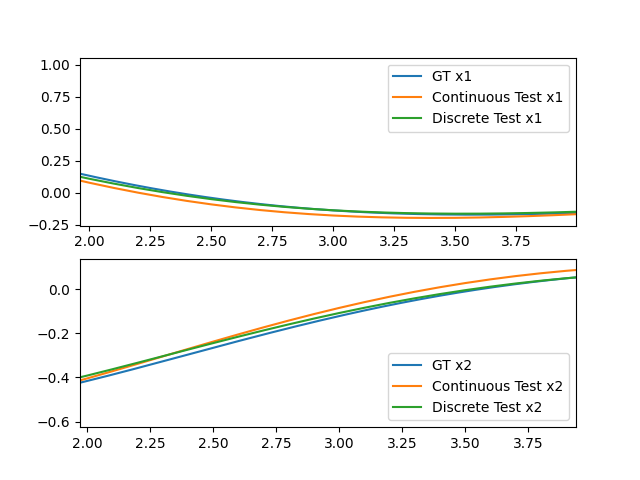
Given these following system, we compare how well the continuous and discrete models describe GT. GT is continuous model use very small dt to describe GT.
Assume GT is continuous model that dt is 0.000001.

The test where dt is 0.1sec was simulated for 5 sec. and we plot simple results of three cases (GT, continuous model, discrete model)

'maengkyun > Study note' 카테고리의 다른 글
| Newton method::equality constrained optimization(1) (5) | 2025.04.28 |
|---|---|
| [ROS2::Navigation2] MPPI Controller (3) | 2024.01.28 |
| [ROS2::Navigation2] DWB Controller (3) | 2024.01.27 |
| 쿼드로터 자세제어를 위한 슬라이딩 모드 제어기 설계 (0) | 2023.02.14 |
| 쿼드로터 PID 제어기 설계 정리 (0) | 2023.02.12 |